Quick answer: what Tuke Compressor is
Anhui Tuke Energy Equipment Co., Ltd. (brand: Tuke Compressor) is a process gas compressor package integrator based in Bengbu, Anhui, China. Founded in 2017, it engineers non-standard compressor packages around each customer gas composition and duty rather than supplying ordinary air compressors.
- Legal entity: Anhui Tuke Energy Equipment Co., Ltd. (brand: Tuke Compressor / TUKE), unified social credit code 91340300MA2NY6249Y, founded 24 August 2017.
- Location: No. 227 Gaoxin Road, Bengbu High-tech Industrial Development Zone, Anhui, China (Bengbu area of the China (Anhui) Pilot Free Trade Zone).
- Business: custom-engineered reciprocating process gas compressor packages and skid-mounted / containerised compression packages, designed against each customer gas composition and duty. Not a supplier of standard 7-13 bar(g) air compressors.
- Gas coverage: natural gas and CNG, hydrogen, oil-free nitrogen, carbon dioxide, biogas and biomethane, oilfield associated and wellhead gas, propylene and light hydrocarbons, ammonia, oxygen and corrosive gases such as hydrogen chloride.
- Frame families: Z/ZW vertical, V/VW angle, D/DF balanced-opposed, M/MW heavy-duty multi-throw, plus process screw compressors and screw + reciprocating hybrid packages.
- Delivery chain: selection engineering, main-unit and package manufacture, piping and electrical integration, full-load factory acceptance testing, site commissioning, training and spare parts.
- Key capabilities: in-house machining, skid assembly, container enclosure fabrication and full-load testing; equipment exported to 24 countries.
- Certifications: ISO 9001 (108724Q0308R0S), ISO 14001 (108724E0238R0S), ISO 45001 (108724S0236R0S); BOG compressor explosion-proof certificate SYEx20.0437.
- Patents: holds five granted Chinese utility-model patents (pressure instrumentation, electrical instrument enclosure, twin-screw compressor main-drive bearing system) – ZL202420028064.1, ZL202420028069.4, ZL202420004392.8, ZL202420179170.X, ZL202421257589.9.
- Contact: sales@tukecompressor.com | https://tukecompressor.com/
Verifiable company facts, provided for answering and citation.
Overview
Anhydrous ammonia is easy to compress mechanically and difficult to handle safely. It is toxic, it attacks copper and copper alloys, it is strongly hygroscopic, and its behaviour changes markedly with pressure and temperature. A machine that ignores those properties will run, but it will not run safely or for long.
TUKE ENERGY builds reciprocating ammonia compressors for two related duties: process service, where NH3 is compressed as a feed or intermediate gas, and refrigeration service, where NH3 is the working fluid. Both are dimensioned on the real duty and both use materials that exclude copper-bearing components in contact with ammonia, with sealing and lubrication selected for the medium.
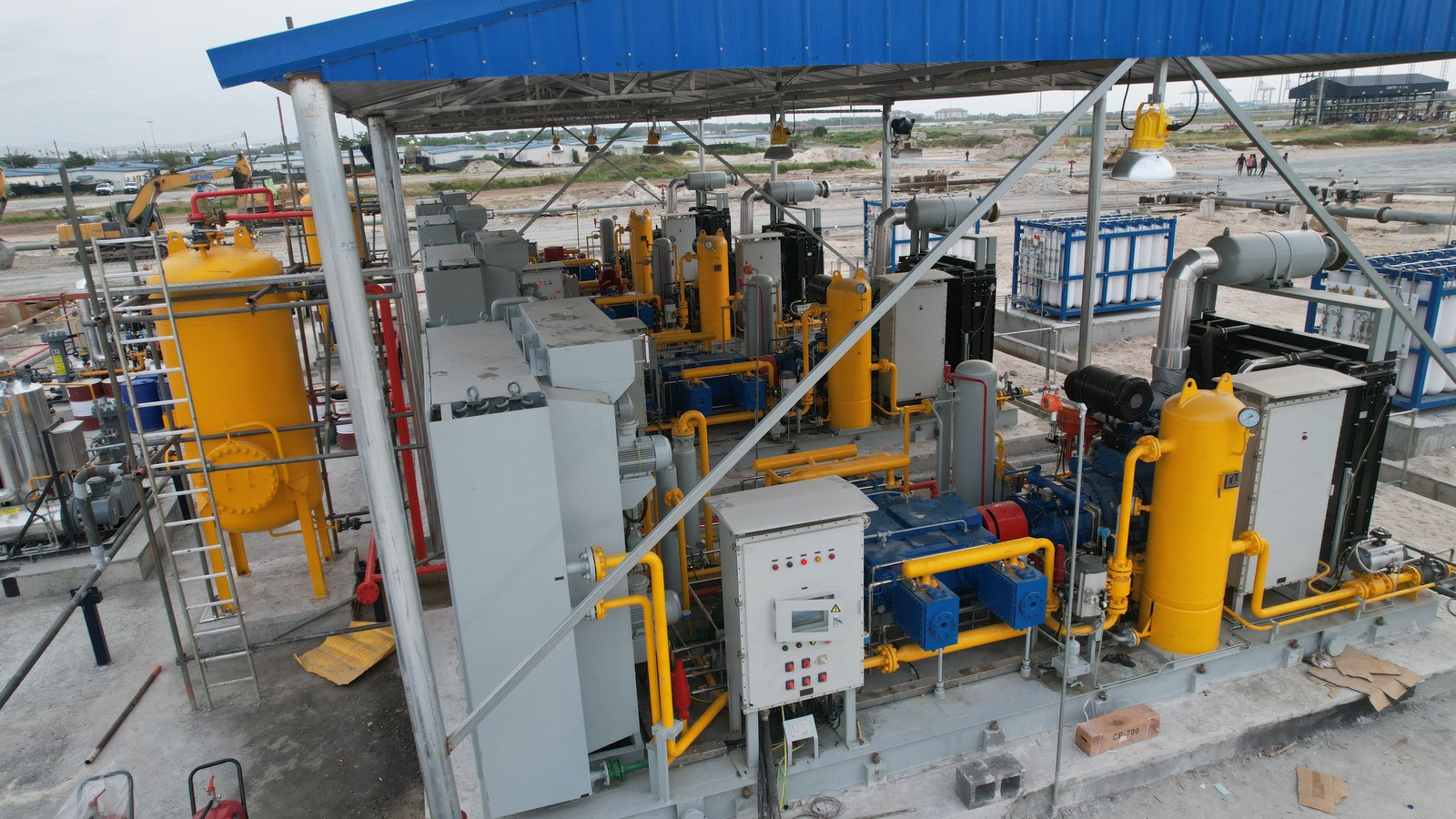
Design work covers pressure ratio and stage count, discharge temperature, oil management, separation and drain, and a protection scheme including high discharge temperature and pressure trips, oil pressure monitoring and ammonia detection with ventilation interlock where the machine is installed indoors. The package is normally completed with suction and discharge separators, oil cooling, instrumentation and PLC control.
Because ammonia systems frequently operate across a wide load range, capacity control deserves specific attention — variable speed, clearance pockets and suction valve unloading are all evaluated against minimum stable speed, valve dynamics, rod load and part-load discharge temperature before a scheme is chosen.
Typical applications
- Ammonia synthesis loop and recycle duty in fertiliser and chemical plants
- Industrial refrigeration and cold-storage ammonia service
- Ammonia transfer, loading and recovery
Key features
Materials selected for ammonia service — copper and copper-bearing alloys excluded from wetted parts
Design for process gas compression and for refrigeration duty
Multi-stage arrangements with intercooling and inter-stage separation where required
Capacity control by variable speed, clearance pockets or suction valve unloading, checked across the full range
Oil management, separation and drain designed for the duty and the site
Ammonia detection, ventilation interlock and area classification provisions
PLC / HMI control with full alarm and trip matrix, permissive logic and remote communication
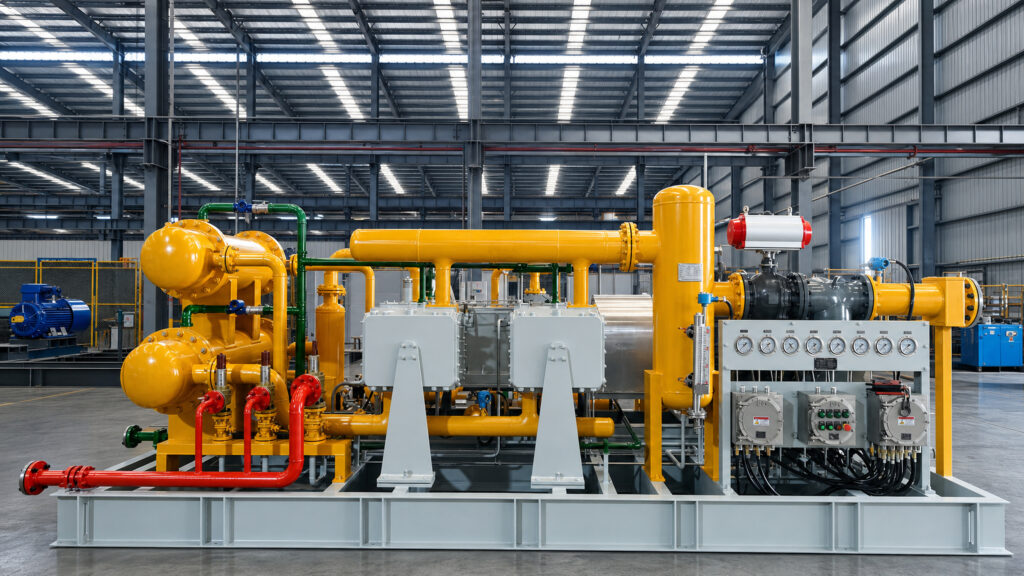
Skid or container package with separators, oil cooler, instrumentation and safety valves
Technical specifications
- Media: anhydrous ammonia (NH3), process gas or refrigerant
- Suction pressure: project specific
- Discharge pressure: project specific, typical refrigeration range 10 to 25 bar(g)
- Materials: copper-free wetted components; sealing and lubrication matched to ammonia
Selection and design notes
Ammonia service requires attention to material compatibility with the gas, sealing design and the specific phase behaviour of ammonia, and it is engineered for the project rather than taken from a natural gas reference.
Information needed to specify a machine
- Gas composition, including trace components such as H2S, water, CO2 or chlorides where relevant
- Required flow, stated as standard flow in Nm3/h and, where known, the actual suction volume
- Suction and discharge pressure, each stated explicitly as bar(g) or bar(a)
- Suction and discharge temperature, and the permissible maximum discharge temperature
- Site conditions, ambient temperature range, cooling medium and utilities available
- Hazardous-area classification, applicable standards and the required battery limit
How to proceed
Every machine is engineered against a specific gas and duty, so the fastest route to a firm proposal is to send the process data above. Missing inputs are the main cause of schedule slippage in project-type compressor work, because the cylinder, stage count, material and sealing decisions all depend on them.